Q3 2026 Market Outlook
Q3 Commercial Real Estate Review: A Stable Carolinas Market
“Commercial real estate conditions across the Carolinas remained stable through the third quarter, supported by continued population growth and steady tenant demand across core asset classes. Retail and industrial continue to lead. Retail availability remains low, as construction over the past several years has been modest and concentrated in suburban submarkets, anchored by national big-box and grocery tenants. Industrial leasing momentum remains steady, with demand focused on new, modern product along the interstate corridors and in port-served markets, as the region absorbs recent deliveries and speculative development slows. In the urban cores, multifamily continues to drive new development, and the momentum is building as more people choose urban living.
Population growth remains the driver of all CRE sectors, as the Carolinas continue to rank among the nation’s leaders in in-migration. Housing demand is driving land sales in suburban markets, with employment and retail following close behind. Entitlement challenges continue to slow new single-family housing supply, and higher mortgage rates are constraining demand, thus the housing sector is searching for its equilibrium. Office remains selective, with quality, amenitized and well-located space outperforming older product, and new construction remains limited.
Overall, the market remains stable, but higher long-term rates are the main headwind, weighing on acquisitions, development feasibility and pricing across asset classes. We are hopeful that as energy prices ease, long-term base rates will follow, improving cash flow and project economics. In the meantime, we expect a disciplined but healthy regional market, with new supply following continued population growth. Opportunities are emerging in growing suburbs across the region’s major metros, and renewed activity in urban cores positions the Carolinas for continued growth.”
– Patrick Chambers | Shareholder | NAI Columbia
Industrial
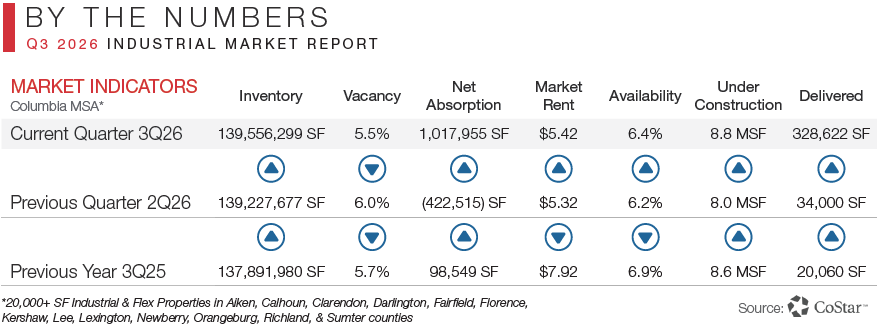
“The industrial market in Columbia, South Carolina, exhibits strong momentum, characterized by record development activity, rising direct lease rates, and low structural vacancy compared to national averages. Positioned along major logistics corridors (I-20, I-26, and I-77) with direct port access to Charleston, the Midlands market continues to capture nearshoring tailwinds and heavy domestic manufacturing investment. Overall direct asking rents have reached new highs, hitting $5.42 per square foot.
Demand remains heavily anchored by large-scale capital projects across the advanced manufacturing, automotive, and clean energy sectors—most notably the multi-billion-dollar Scout Motors EV assembly plant in Blythewood. These mega-developments are triggering secondary demand from Tier-1 and Tier-2 suppliers seeking modern, specialized Class A space across core submarkets like Richland, Lexington, and Northeast Columbia. While spec construction continues to deliver new inventory to meet this demand, sustained absorption keeps fundamentals balanced, positioning Columbia as a premier regional industrial hub in the Southeast.”
– Bill Lamar | Senior Associate | NAI Columbia
VIEW FULL INDUSTRIAL REPORT HERE
Office
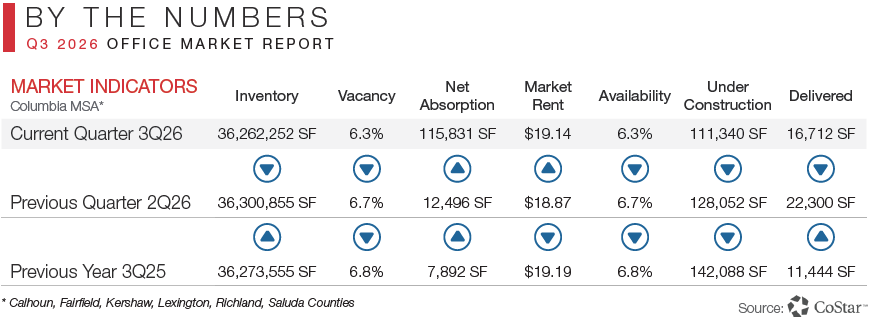
“The Columbia market is in a good position heading into Q4. Vacancy has tightened to 6.3%, absorption jumped to 116K SF, and rents increased to $19.14/SF. The CBD continues to lead the market at 5.1% vacancy and $21.24/SF rents. Overall, demand is strengthening, supply is controlled, and the market continues to move in the right direction.”
– Hope Andrews | Associate | NAI Columbia
Retail
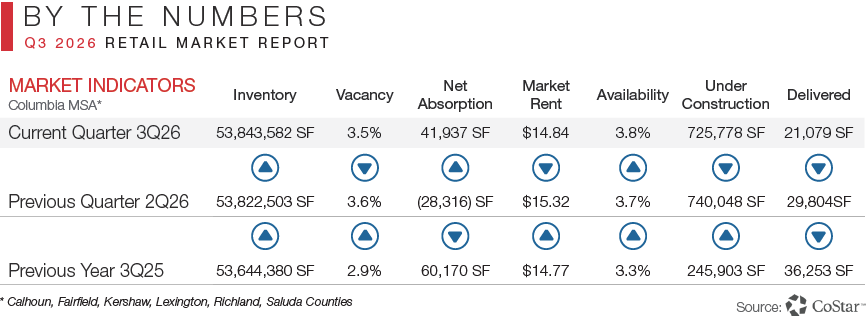
“If you take a look at Columbia’s retail scene right now, the market is quietly putting up some of the strongest fundamentals we’ve seen in years. Fueled by steady population growth and an impressive influx of new residential rooftops, demand for space in Q3 was intense across both the urban core and high-growth suburban trade corridors. Because high construction costs and interest rates kept a lid on new speculative buildouts, landlords held a massive upper hand—pushing regional vacancy down near record lows around 4% and keeping asking rents on a solid upward trajectory. The third quarter was really defined by major urban milestones and selective suburban infill.
The biggest story in town was at BullStreet, where official site prep and construction started on the long-awaited urban Publix, proving that retailers are eager to follow high-density urban residential growth. Meanwhile, prime suburban centers in Harbison, Lexington, and West Columbia saw fast-paced backfilling, with national brands like J.Crew Factory and Academy Sports locking down footprint. As we head into Q4, expect this tight-inventory environment to persist. Well-anchored grocery centers and premier outparcels will continue to command top-dollar rents and quick absorption, closing out 2026 as one of the most competitive retail environments in the region.“
– Sam Edens | Associate | NAI Columbia